
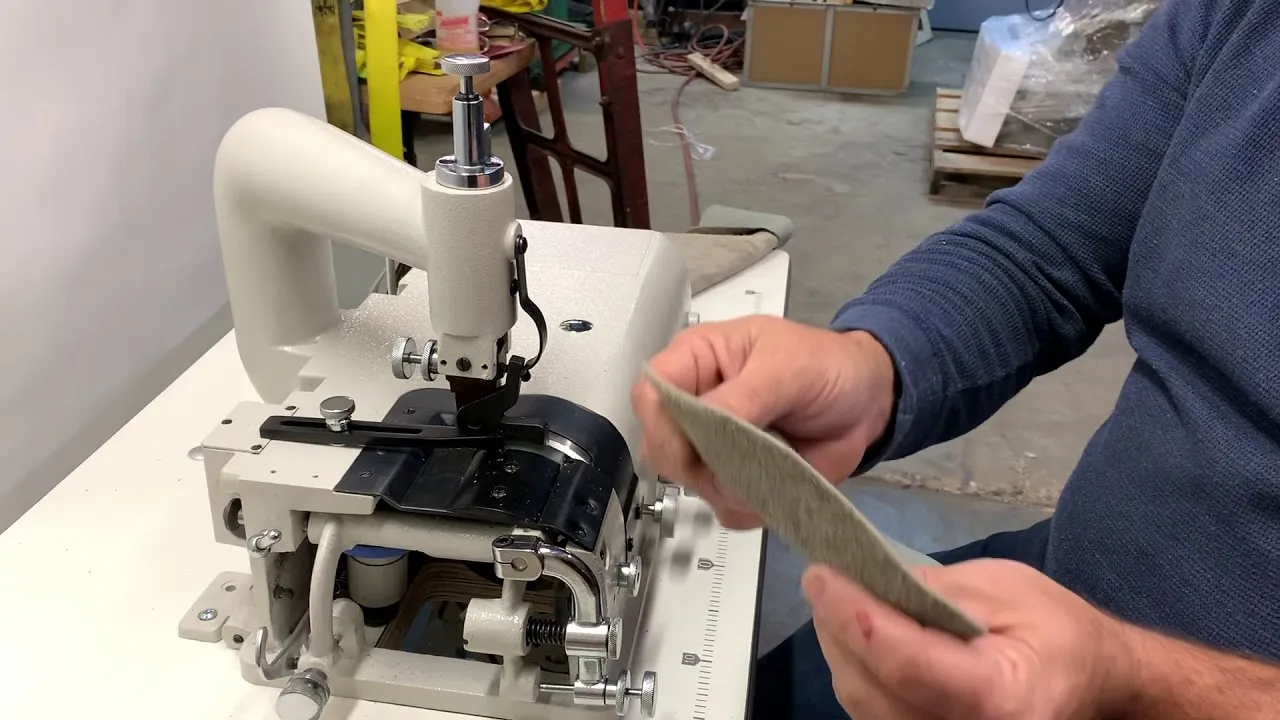
A bell knife skiver thins the edge of a leather piece so that a folded edge or a seam is not bulky. It is a simple machine, but it has to be set up right, and most of the trouble people have with skivers comes from three things: the feed roller, a dull knife and a shoe set by guesswork. This guide follows Sergey's skiver videos, which are the most watched on our channel: how the machine works, how to set it, how to skive, and how to keep it sharp.
What skiving is for
When you fold an edge over, sew two pieces face to face and turn them, or bind an edge, the leather doubles or triples in thickness right where the seam is. Skiving shaves the back of the leather along the edge into a taper, so the finished edge is thin and clean and nothing sticks out after the seam is turned. Bag makers, wallet makers, automotive and furniture upholsterers, and belt makers all skive.
How a bell knife skiver works
The knife is a steel bell, a ring with a sharpened edge, that spins on its own axis. The leather is fed past the edge by a feed roller underneath and held down by a presser foot, which skiver operators call the shoe. The gap between the shoe and the knife decides how much leather is left; a guide decides how far in from the edge the skive goes.
| Bell knife | The spinning cutting ring. Sharpened in the machine by a built-in grinding stone. |
|---|---|
| Feed roller | Pushes the leather past the knife. Stone (rough) or neoprene (smooth). |
| Shoe (presser foot) | Holds the leather against the roller. Its setting decides the final thickness. |
| Edge guide | Sets how wide the skive is, measured in from the edge. |
| Roller adjustments | Move the roller in and out, and set its angle to follow the knife. |
Two motors: why we set skivers up this way
On many skivers one motor drives everything, so the knife slows down when you slow the feed. We set ours up with two motors. A continuous running motor spins the knife at one steady speed as soon as you switch it on. A second motor, a servo like the one on a sewing machine, drives the feed and runs only when you press the pedal.
That separation is what makes curves possible. The knife keeps cutting cleanly at full speed while you slow the feed to a crawl with your foot and turn the piece around a corner. With a single motor, slowing down for a curve also slows the knife, and the cut gets ragged.
Stone roller or smooth roller
Most skivers come with a stone feed roller, which is rough and grips hard. The trade-off is that the shavings the knife takes off can stick to a rough roller and come back around under the leather. That makes a bump, the knife cuts into the bump, and you get a hole in the piece. On fine leather it ruins the part.
For delicate and soft leather, bags, wallets, upholstery and seats, we fit a smooth neoprene roller. Shavings do not stick to it. It grips a little less, so it needs a really sharp knife to feed well, but the result is clean. For thick, dense leather such as belt and saddle leather, the grip of a stone roller is worth it; that is what the 801H top feed skiver below is built around.
Setting the roller
The feed roller has two adjustments: one moves it in and out, the other sets its angle. Set it as close to the knife as you can, following the shape of the bell. If there is too much gap between roller and knife, there is nothing to push the leather into the edge, and no matter how you turn the other adjustments, nothing will skive. If a skiver suddenly stops feeding, check this gap first.
Setting the thickness: the shoe
This is the adjustment that everyone who runs a skiver has to understand.
- Turning the shoe in leaves a thinner edge. Turning it out leaves more leather.
- It takes very little turn to make a difference. Move it a small amount at a time.
- The skiver works off the thickness of the leather, so every new hide needs its own test. Always take a scrap of the same leather, skive it, check it, and only then skive the real pieces.
- Once a piece is skived too thin, there is no going back. That is why the scrap test matters.
A good target for a turned seam or a folded edge is to take out about the thickness that would otherwise stick out after the seam is turned, so the edge lies flat.
Skiving, step by step
- Switch on the knife motor. Set the edge guide for the width of skive you want.
- Test on a scrap of the same leather and adjust the shoe until the edge is the thickness you want.
- Feed the piece with the pedal. If the leather does not pick up, slip the edge under the shoe and bring it down so the roller has material to take hold of.
- On straight runs you can go faster. Slow right down on curves and turn the piece as you go.
- Soft leather wrinkles easily, so slow down and take your time with it.
- Shavings build up around the knife. Never put your fingers in there; pull them out with tweezers. A bag under the machine catches the waste if you do not have a vacuum system.
Keeping the knife sharp
A sharp knife is the difference between a skiver that feeds itself and one you fight all day, especially with a smooth roller. The 801 has its own sharpening system: a grinding stone inside the machine.
- With the machine running, engage the stone with its lever, then turn the knob slowly to bring the stone against the spinning knife.
- A light touch is usually all it needs. If everything is set right, you only sharpen once in a while.
- Then take a hand stone and touch the inside of the bell to take off the small burr the grinding leaves. Never touch the outside of the edge: that ruins it.
- When you finish, always turn the knob back to move the stone away, then release the lever. If you switch the machine off with the stone still against the knife, it will stall next time you switch on, because it cannot start everything at once.
If you grind and grind and the knife does not get sharper, look at the stone. Over time oil and leather dust load it until it turns black and simply glides against the knife; you will not see sparks. Clean it with a rough dressing stone and it will cut again.
When the knife has worn shorter
Every sharpening takes a little off the bell, so after heavy use the knife gets shorter. When the machine is new, the edge of the knife sits almost even with the edge of the shoe. Once a gap opens up there, an eighth of an inch or so, the machine no longer skives properly because the knife is out of alignment.
The knife is made to be reset. A knob moves it over to close the gap. But be sure you need to before you do it: after a reset, the stone meets the knife at a new place and starts grinding from the back, not the edge. Expect 15 minutes to half an hour of grinding before it reaches the edge and the knife actually sharpens. Normally you only touch it up and it is ready to go; a reset is a once-in-a-while job.
Oiling and greasing
A skiver is not a high maintenance machine, but a few points need attention:
- The main shaft: turn the small cover until the hole lines up and put a few drops of oil in.
- The roller shaft has its own oil hole; it runs at an angle, so aim slightly to the right.
- The gears behind the rear cover: every six months or so, depending on use, take the cover off and pack them with grease.
- Keep the oil points covered so leather dust does not get in.
801 or 801H: soft leather or thick leather
We set up two skivers, and the leather decides which one.
| SEWPRO 801 | Soft and medium leather: bags, wallets, upholstery and automotive seats. Smooth neoprene feed roller, two motors, pedal-controlled feed. |
|---|---|
| SEWPRO 801H (top feed) | Thick, dense leather: belt leather, straps, saddle work. Stone bottom roller and a driven top roller that feed together, for grip in heavy leather. |
Both come on a short, space-saving table, and we can set the 801 up to work standing. Edge skiving a belt strip so it folds over cleanly is a job for the 801H; it is too thick for the standard machine.
Questions people ask
Why won't my leather skiver feed?
Usually the gap between the feed roller and the knife is too large, so there is nothing pushing the leather into the edge. Move the roller in close and set its angle to follow the bell. A dull knife also stops feeding, especially with a smooth roller.
Why is my skiver cutting holes in the leather?
Shavings sticking to a rough stone roller come back under the leather and make a bump that the knife cuts into. A smooth neoprene roller prevents it on soft and delicate leather.
How do I sharpen a bell knife?
With the machine running, engage the built-in stone and bring it lightly against the knife, then remove the burr from the inside of the bell with a hand stone. Back the stone off before switching off. Never stone the outside of the edge.
How thin should I skive?
Enough that the folded or turned edge lies flat, without weakening the piece. Every hide is different, so test on a scrap of the same leather first; once a piece is skived too thin it cannot be fixed.
Skiving is usually one step in a leather workflow; for the machine that sews the skived pieces, see our leather sewing machine guide.
Talk to us
Interested in the SEWPRO 801 or 801H skiver, or need help with the one you have? Tell us what leather you skive and we will set it up for it.