
People call us and ask for "the best upholstery sewing machine." There is no such thing, and anyone who names one without asking what you sew is selling you what they have in stock. Upholstery is five or six different sewing jobs. This guide goes through them one at a time, says which kind of machine does each one well, and then answers the question people actually mean: if I can only buy one machine, which one?
What makes an upholstery machine different from a garment machine
A garment machine moves one or two layers of thin cloth with a feed dog under the material and a presser foot holding it down. Upholstery does not work like that. A seat seam might be two layers of vinyl, a layer of half inch foam, a listing strip and a welt cord in the middle. The top layer and the bottom layer are different materials with different friction. On a drop feed machine the bottom layer gets pulled along by the feed dog and the top layer stays put under the foot, so by the end of a 40 inch seam the top is an inch longer than the bottom and the panel puckers.
The fix is compound feed, which the trade also calls unison feed, triple feed or walking foot. Three things move the material together: the feed dog from below, the inner presser foot from above, and the needle itself, which stays in the material while it moves. Everything travels at the same speed, so four layers come out the far end the same length they went in.
Beyond the feed, four numbers on a spec sheet tell you whether a machine is an upholstery machine:
- Stitch length. Upholstery seams run 6 to 9mm, about 3 to 4 stitches per inch, for strength and looks. A machine that tops out at 5mm cannot sew a proper topstitch on a seat.
- Foot lift. You need to get a thick, folded assembly under the foot. 14 to 16mm (about 5/8 inch) is the working minimum.
- Hook size. A standard hook holds a small bobbin and takes thread up to about size 92. Upholstery runs 92 and 138, so you want a large (L or M) bobbin and a hook designed for the heavier thread. Fewer bobbin changes, fewer thread problems.
- Needle system. 135x17 in sizes 110 to 180 is the upholstery standard. It is widely available and Schmetz makes it in every point type.
The six upholstery jobs and the machine for each
1. Panels, boxing and welt seams: compound feed flatbed
This is 80 percent of the work in a furniture or automotive shop: sewing flat panels together, running welt cord into the seam, attaching boxing strips to cushion tops, closing zipper plackets. The machine for it is a single needle compound feed flatbed with a large hook, a 9mm stitch and a tall foot lift, fitted with a welt foot that has a groove sized to your cord.
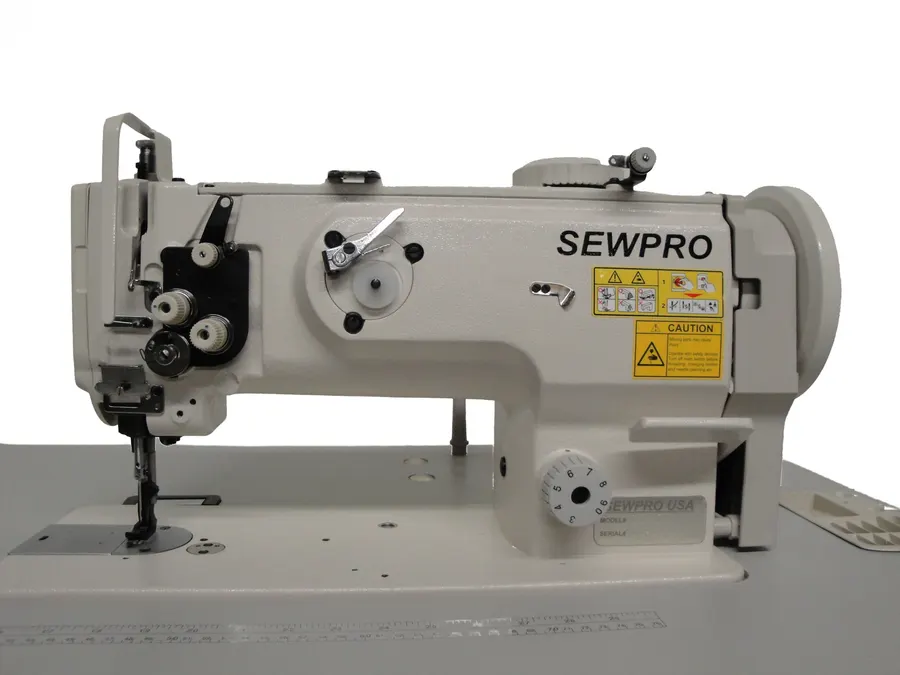
In our catalog that is the SEWPRO 1541S and the 1508NH. Both are built on the two most common heavy-duty flatbed platforms in the world, which matters because every welt foot, zipper foot and hook made for those classes fits. The 1541S has a horizontal hook with an M bobbin and a safety clutch; the 1508NH has a vertical hook and runs a hair quieter at speed. Shops are happy with either.
2. Decorative double topstitch: double needle
The two parallel rows of stitching down a seat bolster or along a sofa arm are a double needle seam. You can do it on a single needle machine with an edge guide and two passes, and small shops do, but the rows are never quite parallel and it takes twice the time. A double needle compound feed machine with a split needle bar sews both rows in one pass at a fixed gauge, and the split bar lets you lift one needle at a corner so both rows turn without a gap.
The SEWPRO 1560N is the double needle version of the 1508 platform, with two large vertical hooks. The 1560N-7 adds an automatic thread trimmer and back-tack, which on decorative work saves a surprising amount of hand trimming.
3. Headrests, armrests, shift boots: post bed
Small, three-dimensional automotive pieces cannot be laid flat. A headrest cover is sewn inside out and then the topstitch has to go on from the outside, around a shape the size of a loaf of bread. A post bed raises the sewing point onto a column so you can hang the piece over it and turn it under the needle. Automotive trim shops that do a lot of this own a post bed; furniture shops mostly do not.
The SEWPRO 1760 is a triple feed post bed with a 7 inch post and a large hook, set up for heavy thread topstitching on leather and vinyl. The 243H-P2 is a double needle post bed for parallel rows on shaped pieces.
4. Carpet binding and edge binding: cylinder arm with a binder
Automotive carpet, floor mats and the edges of boat cushions are finished with a folded tape sewn over the edge. A binder attachment folds the tape and presents it to the needle; a cylinder arm lets the edge of a curved piece sit flat under the binder. The SEWPRO 335VB is built for this and comes with the binder fitted and adjusted for your tape. Sergey has a video on carpet binding on our videos page.
5. Large pieces: long arm
Sofa back covers, mattress covers, RV cushions, truck seats, boat tops. When the piece is big, the limiting factor is the 10 inches between the needle and the arm on a standard head. An 18 inch long arm doubles that. It sews exactly like the flatbed above, with the same hook and feet; it just gives you room. Furniture shops that do a lot of sectionals and automotive shops that do carpet sets and headliners usually end up with one. See the SEWPRO 1508L-18 and the 0617DL-18-7 with automatic trimming.
6. Extra heavy work: 733 class or 441 class
Some upholstery is heavier than the compound feed flatbed is designed for: tractor and heavy equipment seats with 207 thread, motorcycle seats in thick leather, horse blankets with webbing. The SEWPRO 733-PRO is an extra heavy-duty flatbed with a barrel shuttle hook that takes thread to 346. For curved heavy work, a 441 class cylinder arm. Most upholstery shops never need either; the ones that do know who they are.
If you can only buy one machine
What to look for on the spec sheet
| Feed | Compound (needle, inner foot and feed dog all move) |
|---|---|
| Max stitch length | 8 to 9mm |
| Foot lift | 14 to 16mm by knee or air |
| Hook | Large vertical or horizontal, L or M bobbin |
| Thread | Bonded nylon or polyester 69 to 138, 207 on heavy models |
| Needle | 135x17, sizes 110 to 180 |
| Speed | 2000 to 2500 spm rated; you will run 300 to 800 |
| Motor | Servo, 550 to 750W, with needle positioner |
Three things that matter more than the brand
The motor. An upholsterer sews slowly around corners and fast down long seams, and stops with the needle down to pivot a hundred times a day. A clutch motor makes all of that hard. A servo motor with a needle positioner makes it easy, runs silent and uses a third of the electricity. Every machine we sell has one. If you are buying used, budget for the conversion.
The feet. A compound feed machine comes with a standard foot set. Upholstery needs welt feet in at least two cord sizes (5/32 and 3/16 are common), a left and right zipper foot, and often a Teflon foot for sticky vinyl. The feet turn the machine into a tool for your product. Make sure the quote includes them.
Who set it up. Hook timing, needle bar height, foot pressure, tension: a machine that was crated at a factory and uncrated in your shop will sew, but it will not sew your material well until someone adjusts it. We time and set every machine on the material the customer sends before it leaves Ephrata, and again when we install it. That is the difference between a machine that works on Monday and one that works in three weeks.
Common problems and what they usually mean
- Top layer longer than bottom at the end of a seam. You are on a drop feed or a plain walking foot, not compound feed. Or the foot pressure is far too high.
- Skipped stitches on vinyl. Needle too small for the thread, or a worn needle. Go up a size and change it more often. Hook timing comes second.
- Loops on the underside. Top tension too loose or the thread is not seated in the tension discs. Rethread with the foot up.
- Stitch length shrinks on thick sections. Normal on any machine to a degree. A compound feed with a climbing device, like the 1541S, handles seam crossings better than one without.
- Needle marks on leather. Wrong foot (use a smooth or Teflon foot) and too much foot pressure.
Questions people ask
Can a heavy-duty domestic machine do upholstery?
It can sew two layers of vinyl slowly. It cannot sew a welt seam in four layers with 138 thread, and it will not last a year of daily use. If you upholster for money, buy an industrial compound feed machine.
What thread should an upholstery shop use?
Bonded polyester or bonded nylon, size 92 for most furniture and automotive seams, 138 for topstitch and heavier work. Polyester holds up better to sun; nylon is a little stronger. Match the needle size to the thread.
New or used?
A good used compound feed head with a new servo motor is a fine way to start if someone you trust has gone through it. A new machine from a dealer who sets it up and warranties it is less risk for not much more money. We sell both when we have them.
How much space does an upholstery machine take?
A standard table is about 48 by 20 inches; a long arm table about 60 by 20. Allow room to swing a sofa cushion around the needle, so figure 5 by 6 feet per machine.
Machines in this article
- SEWPRO 1541SHeavy-Duty Walking Foot Lockstitch Sewing Machine
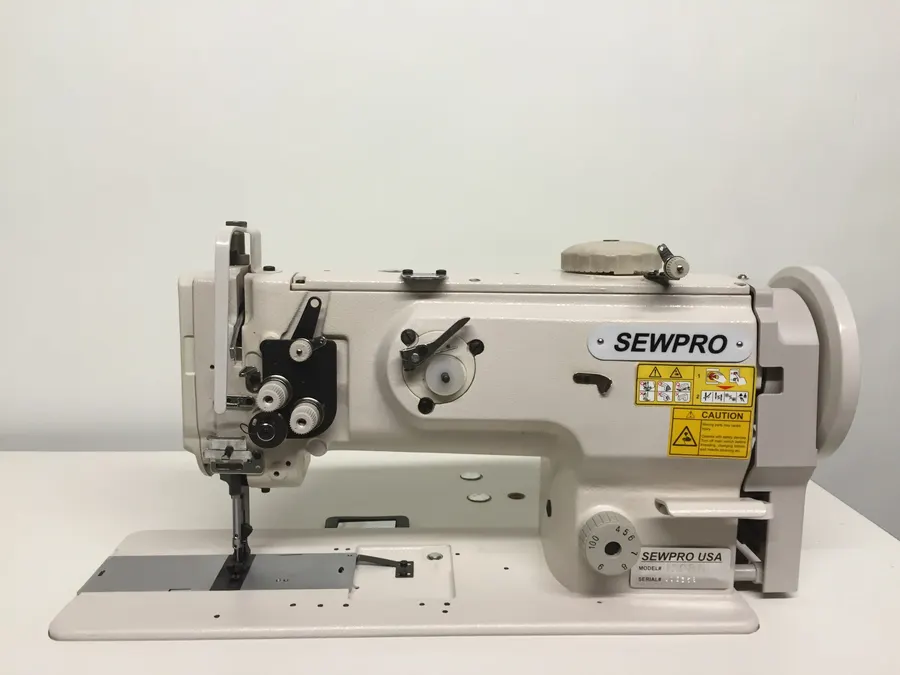 SEWPRO 1508NHUnison-Feed Lockstitch for Extra Heavy-Weight Materials
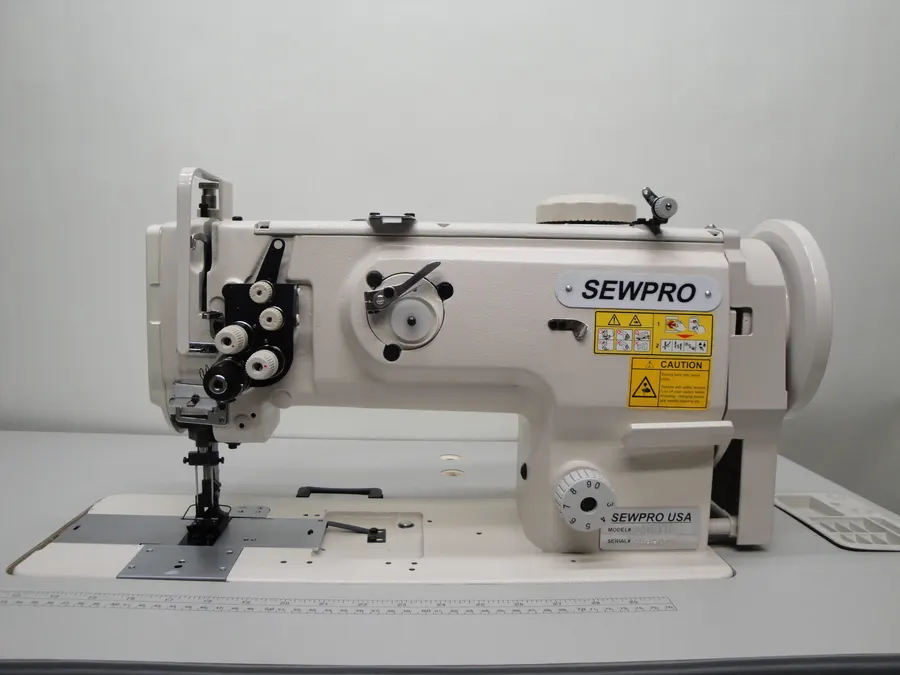 SEWPRO 1560N2-Needle Walking Foot Lockstitch for Heavy Upholstery
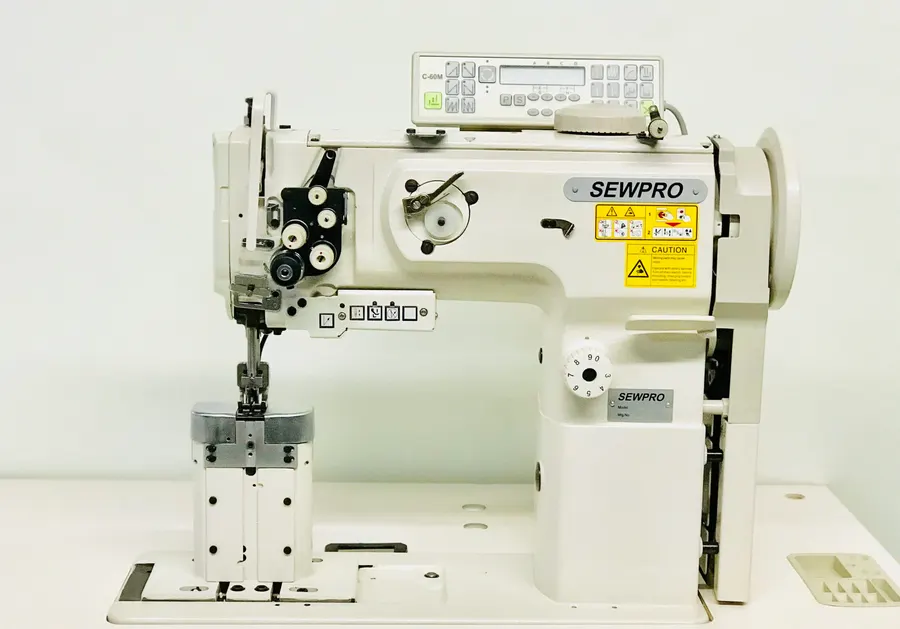 SEWPRO 1760Post-Bed Double Needle Unison Feed Lockstitch Machine
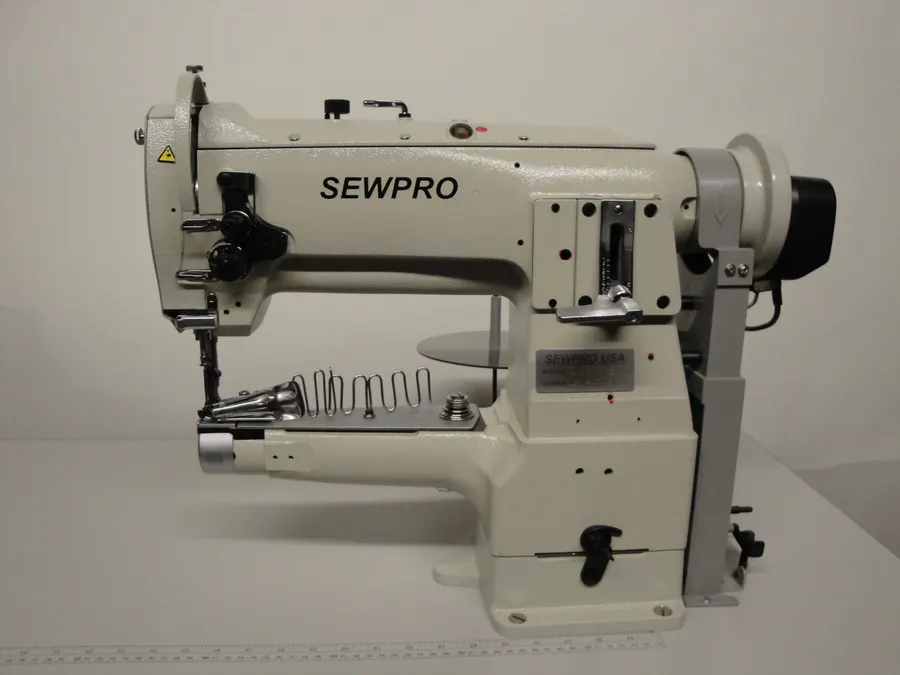 SEWPRO 335VBCylinder-Bed Binding Sewing Machine for Leather and Upholstery
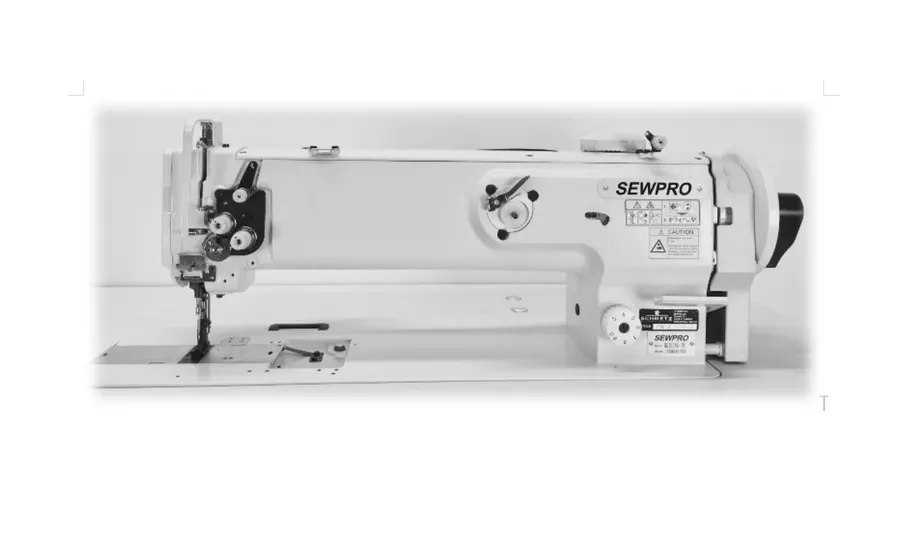 SEWPRO 1508L-18Long-Arm Walking Foot Lockstitch Machine
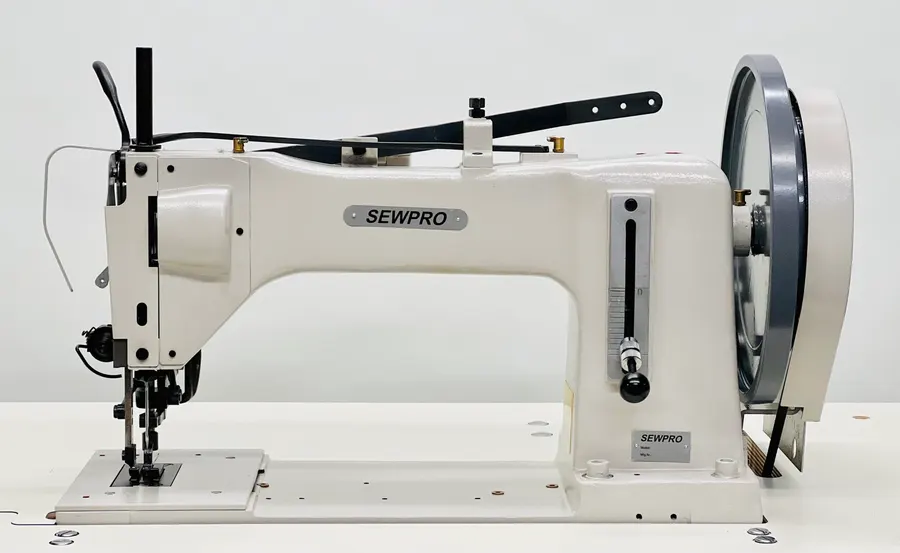 SEWPRO 733-PROExtra Heavy-Duty Lockstitch Sewing Machine
Talk to us
Starting or re-equipping an upholstery shop? Tell Sergey what you sew and he will quote the right machine, set up with welt feet and a servo motor.