
Every belt, bag strap, bridle rein, dog collar and binding strip starts as a strap cut from something bigger. Shops cut them with a hand strap cutter, a straightedge and a knife, or a rotary cutter and a mat, and every one of those methods is slow and drifts a little. A strap cutting machine does the same job with a motor, a set of circular blades and a feed roller, and it does not drift. This guide explains how the machines work, what the numbers on the spec sheet mean, and how to decide whether one pays for itself in your shop.
How a strap cutting machine works
The heart of the machine is a shaft carrying a set of circular blades that can be slid along it and locked at any spacing. Below the blades is a driven feed roller; above, a pressure roller holds the material flat. You feed the edge of a hide, a roll of webbing or a sheet of vinyl between the rollers, the feed pulls it through, and the blades slit it into straps of exactly the width set by the blade spacing. A foot pedal controls the motor so you can start, stop and reverse with both hands on the material.
Because the blades are set once and the roller feed does the work, every strap is the same width from end to end and from the first strap to the hundredth. That consistency is what you are paying for. A hand cutter follows the edge you give it, so if the hide edge wanders, the strap wanders; a machine cuts parallel to its own blades regardless of the edge.
The numbers that matter
| Maximum material width | How wide a piece can go through: 3 3/4 in on the Model 4, 14 in on the AK-20 (open-ended, so wider material can overhang). Decides how many straps per pass. |
|---|---|
| Minimum strap width | How close two blades can sit: about 1/16 in on the Model 4, 2mm with the thinnest spacer on the AK-20. For laces and fine binding. |
| Maximum thickness | 1/4 in on the Model 4 covers belt and harness leather, webbing and most vinyl. 3/8 in on the AK-20. |
| Blade count | How many straps per pass. More blades, more straps at once, more adjusting between widths. |
| Drive | Gear reduction motor for torque at low speed. Foot pedal with reverse to back material out. |
| Power | 110V on the Model 4; check for larger machines. |
The two machines we sell
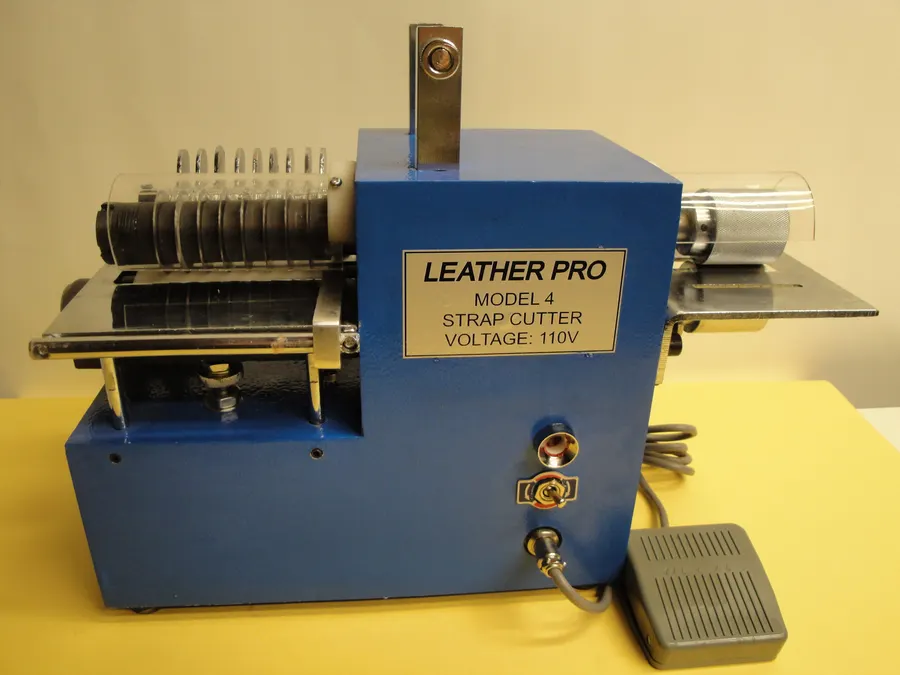
LEATHERPRO Model 4
A compact bench machine for leather shops, saddlers, belt makers and upholstery shops that cut their own welt and binding. It takes material up to 3 3/4 inches wide and 1/4 inch thick and cuts any width from 1/16 inch up. The built-in gear reduction motor runs on 110V and the pedal gives you speed and reverse. It is portable enough to move between benches and quiet enough to run in a small shop. One customer, Elvis Nelson, wrote in his Google review that he received it in a few days and that Sergey had a video tutorial ready for it; that video is on our videos page.
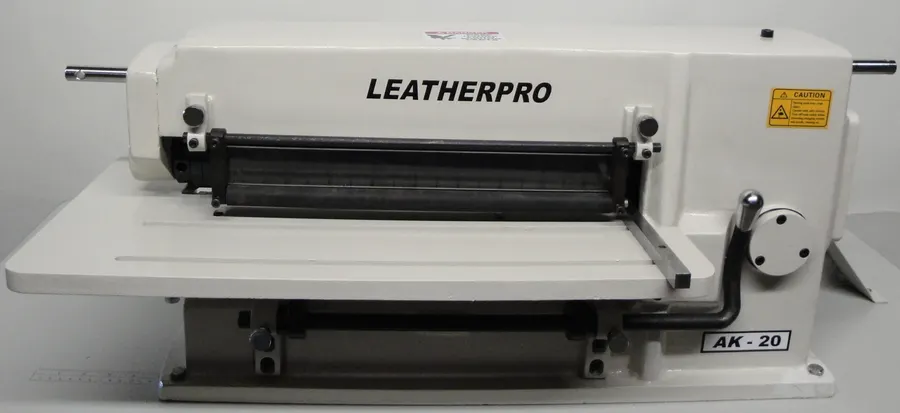
SEWPRO AK-20
A production machine that accepts material up to 14 inches wide and 3/8 inch thick and slits it into many straps in a single pass, with an open-ended roller so wider material can overhang. It ships with eight knives and a full set of spacers. It is for strap and sling manufacturers who bring down rolls of webbing to several widths, bag factories cutting handles and trim from sheet material, and leather goods makers who want to cut a whole side into belt blanks in a few minutes. See the AK-20 page for details.
What gets cut on them
- Belt blanks from sides of bridle or latigo leather, 1 to 1 3/4 inches wide, in one pass down the side.
- Bag and purse straps from leather or vinyl, often several widths from the same sheet.
- Reins, headstalls, cheekpieces, halters in harness leather and biothane for saddle and tack shops.
- Dog collars and leashes.
- Binding and welt strips for upholstery shops that bind their own edges.
- Webbing cut-downs: 4 inch roll to 2 inch straps, 2 inch to 1 inch, for tie-down and sling production.
- Laces and fine strips down to 1/16 inch.
Does it pay for itself?
Work it out with your own numbers. Time how long it takes to cut ten belt blanks by hand, including squaring the edge, and how many you reject for width. A Model 4 cuts a strap as fast as you can feed it, so ten blanks from a side takes a couple of minutes with zero rejects. If you cut more than a few dozen straps a week, the time saved covers the machine in months. If you cut straps occasionally, the real saving is the consistency: no more belts that are 1 1/2 inches at the buckle and 1 7/16 at the tip, and no more wasted leather from a cut that wandered off the edge.
Setting up for a clean cut
Blade spacing. Set with a rule or gauge blocks, then cut a test strip and measure it. Lock the blades firmly; a blade that creeps makes a tapered strap.
Pressure roller. Just enough to keep the material flat against the feed roller. Too much marks soft leather and makes thin material stretch, which gives you a narrower strap than you set.
Leading edge. Start with a square, straight edge. The machine cuts parallel to itself, but the first strap is only as straight as the edge you feed.
Feed speed. Slower on thick, firm leather; faster on webbing and vinyl. The gear reduction motor has torque at low speed, so there is no need to rush thick material.
Reverse. If material jams or wanders, stop and reverse it out rather than pulling. Pulling against the blades dulls them and can shift the spacing.
Keeping it cutting
Circular blades stay sharp for a long time in leather and vinyl and dull faster in nylon webbing and biothane. A dull blade shows as a fuzzy edge on webbing or a dragged edge on leather. Blades are easy to remove and can be honed or replaced; keep a spare set. Wipe the rollers down, keep leather dust out of the shaft bearings, and oil the bearings as the manual says. Store the machine covered in a dry spot; the blade shaft is steel and rusts if left damp.
Questions people ask
Will a strap cutter cut biothane and nylon webbing?
Yes. Both cut cleanly, and both dull blades faster than leather. Keep a spare blade set and expect to hone more often.
Can I cut several different widths in one pass?
Yes. Set the blades at different spacings along the shaft: a 1 1/2 inch belt, a 3/4 inch strap and a 1/2 inch keeper from the same piece in one pass.
How thick can the Model 4 cut?
Up to 1/4 inch, which covers bridle, harness and sole leather singles, and all common webbing and vinyl. Thicker than that, call us.
Do you ship strap cutters?
Yes. The Model 4 ships by parcel, set up and tested, with a video walk-through. The AK-20 ships by freight.
Machines in this article
Talk to us
Tell us what you cut, from what, and how many a week. We will say whether a Model 4 or an AK-20 fits, or whether a hand cutter is still the right tool.