
Rope leashes, lead ropes, rope halters and collars, rope bags and baskets: sewing rope is a growing business, and it is one of the hardest things to put under a needle. Rope is round, thick and often twisted, so it pushes back on the needle and moves under the foot. These are the machines and setups we use for it, from quarter-inch rope bags to rope over 3/4 inch thick, with the settings from our own videos.
Two different rope jobs
Almost all rope sewing is one of two jobs, and they need different machines.
- Stitching rope to itself to make a loop or a splice. The end of a leash, the eye of a lead rope, a halter, a sling. The rope is clamped and a dense, many-row stitch pattern goes through both thicknesses. That is a job for a programmable pattern sewer.
- Joining coils of rope side by side to build a shape. Rope bags, baskets, bowls and mats. A long, continuous zig-zag joins each turn of rope to the one before. That is a job for a zig-zag machine, ideally a cylinder bed.
Stitching rope loops on a pattern sewer
A programmable pattern sewer holds the rope in a clamp and moves the clamp under the needle to sew a stored pattern, the same way it sews a box-X on a strap. For rope, the clamp is a rope clamp shaped to hold two thicknesses side by side, and the pattern is a series of zig-zag rows.
The pattern: narrow first, then wider
The rope patterns we program usually run three rows. The first row is narrow, and each row after it goes wider and tighter, so the stitching pulls the two ropes together first and then locks the full width. The pattern can be made wider, narrower or denser for each job; the machines store 120 patterns, and you can program on the touch screen or design on a computer and load it by USB.
Rope size and machine size
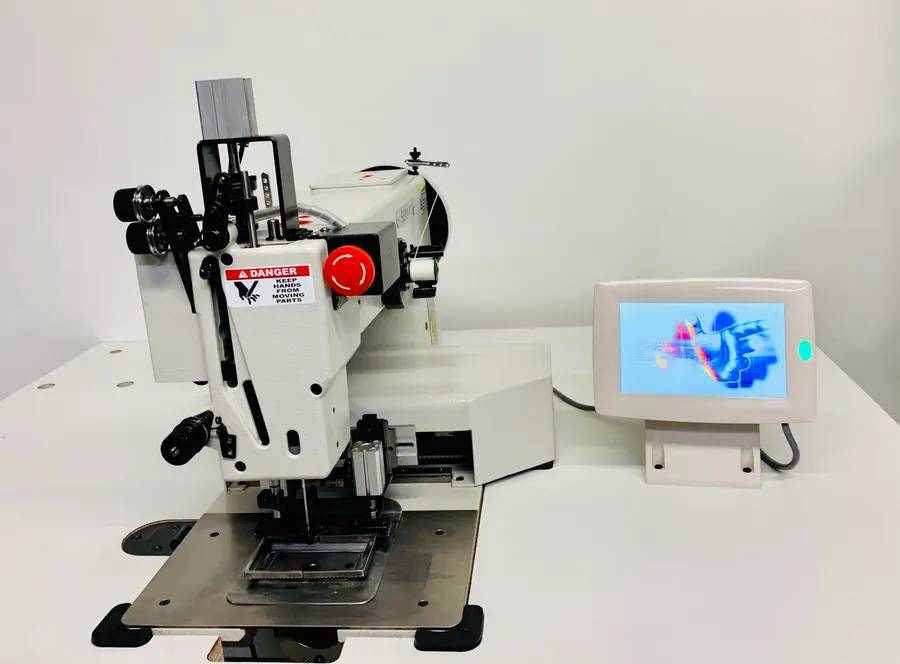
| Rope 8 to 16mm (about 5/16 to 5/8 inch) | PSM-1306 class, 130x60mm field, 794 needles, thread 138 to 346. Leashes, lead ropes, collars, halters. |
|---|---|
| Rope up to about 22 to 26mm (7/8 to 1 inch) | PSM-733-3020, 300x200mm field, 1000H needles, longer needle and stroke. Heavy lines, slings, large loops. |
Thread: 207 is the standard
You might expect the thickest thread for the thickest rope, but rope stitching does not need it. We use size 207 polyester as the standard for rope; 277 works too. The strength comes from the number of stitches and rows in the pattern, and a slightly lighter thread passes through the dense stack with less friction.
Speed: slow down for rope
Every stitch across a rope pattern is a long jump of the clamp, up to the full width of the rope, and the needle is pushing through two round, packed thicknesses. That makes friction and heat. Run rope slowly. On a twisted, rigid poly rope finishing at 16mm wide, we set the PSM-1306 to 150 RPM. On 22mm rope on the PSM-733-3020, slower still.
Twisted rope is harder than braided
A smooth braided rope is the easy case. A twisted rope, especially stiff poly, has high and low spots along its length, so the needle meets a different thickness every stitch, and the hook is more likely to miss a loop. It can be done, with a proper setup: the right clamp, a slow speed and a needle size matched to the thread. Expect to test and tune on your rope before running production.
Very thick rope
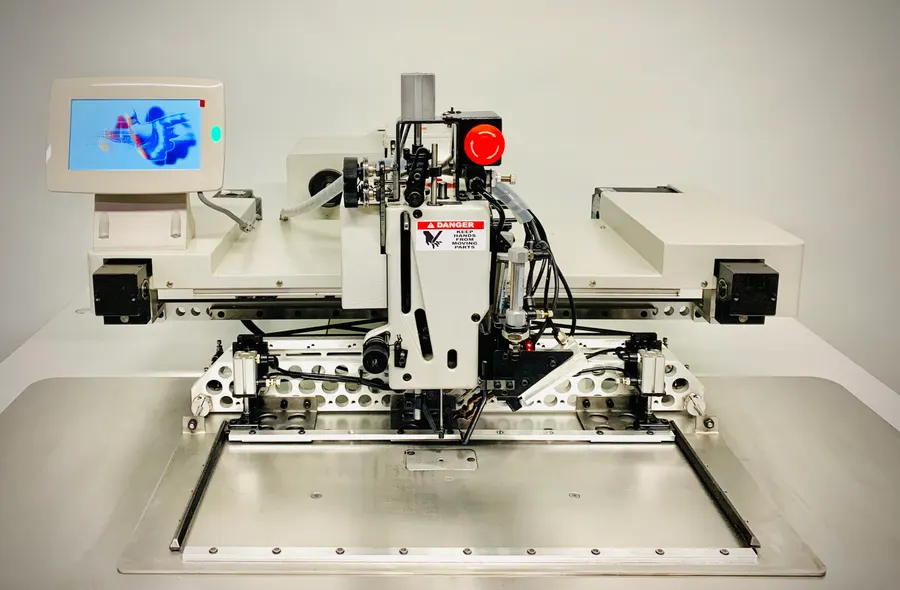
Rope over about 3/4 inch needs the heaviest class of pattern sewer. We set the PSM-733-3020 up for 22mm rope with an 80x22mm pattern. It has a longer needle and a longer stroke, an air-operated clamp, and the 1000H needle system. The machine has a hot knife thread cutter, but on rope this thick we do not use it: there is no room for the parts to move, and it would melt the rope. The optional needle air cooler helps on long production runs.
One machine for rope and webbing
A pattern sewer is not a rope-only machine. Changing the clamp turns it back into a webbing bartacker: on the PSM-1306 the rope clamp is swapped for a rectangular or finger clamp with four bolts behind a cover and a change of air hoses. Shops that make rope leashes often also make webbing collars and tack on the same machine. We also build custom clamps for specific products.
Sewing rope bags and baskets on a zig-zag
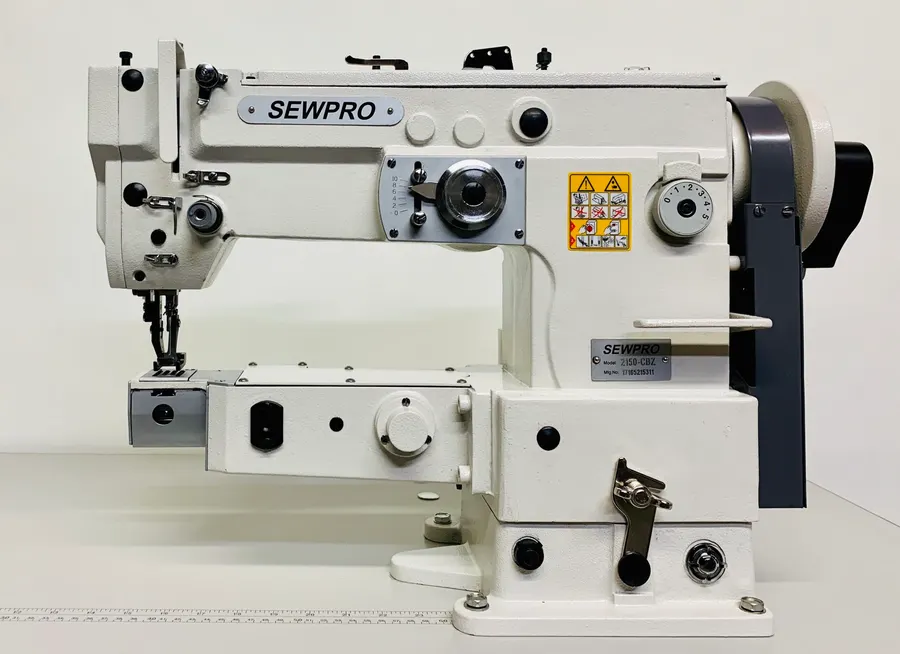
For coiled rope work the machine is a cylinder bed zig-zag. You lay the rope in a spiral and sew a wide zig-zag that catches the turn you are adding and the turn before it; as the piece grows you lift it to shape the sides. The cylinder bed lets the growing bowl or bag wrap around the arm.
We set the 2150-CBZ up for 1/4 inch rope with a few simple additions:
- A small guide to run the rope against, so the spacing stays even.
- A center mark on the foot, so the zig-zag lands centered between the two turns of rope.
- A needle positioning servo set to stop needle down, so the work holds while you reposition, and heel back on the pedal to finish.
- Knee lift with close to half an inch of lift, top and bottom feed, and an M size bobbin for long runs.
- An LED light with three brightness settings, because rope work is close, detailed sewing.
Questions people ask
What machine do I need to sew rope dog leashes?
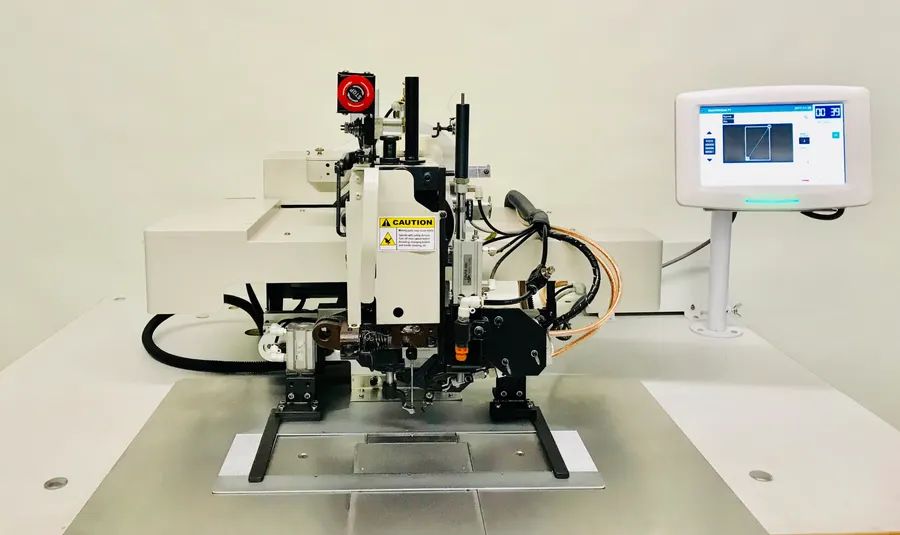
A heavy duty programmable pattern sewer with a rope clamp, such as the PSM-1306CH. It stitches the loop and the end with a multi-row zig-zag pattern through both thicknesses of rope, the same way every time.
What thread should I use to sew rope?
Size 207 bonded polyester is our standard for rope; 277 also works. The strength comes from the stitch pattern, and a lighter thread passes through the dense rope with less friction.
How fast should a pattern sewer run on rope?
Slowly. Each stitch is a wide jump through two round thicknesses. We ran twisted poly rope finishing at 16mm wide at 150 RPM on a PSM-1306.
Can I sew rope on a regular sewing machine?
Thin rope coils for bags and baskets, yes, on a heavy zig-zag. Stitching rope to itself for a leash or halter needs a pattern sewer with a rope clamp; a standard machine cannot hold or pierce two thicknesses of rope reliably.
Machines in this article
Talk to us
Send us a length of your rope and tell us the product. We will set up the clamp and the pattern and send you a sample.