
A programmable pattern sewing machine clamps the part, moves it under the needle along a stored path, sews the pattern, trims the thread and stops. The operator loads and unloads. For the right job it is the best investment a sewing business can make; for the wrong job it is an expensive machine that sits idle. This guide explains how pattern sewers work, what they cost to run, which jobs suit them, which do not, and a simple way to work out whether one pays for itself in your shop.
How a pattern sewer works
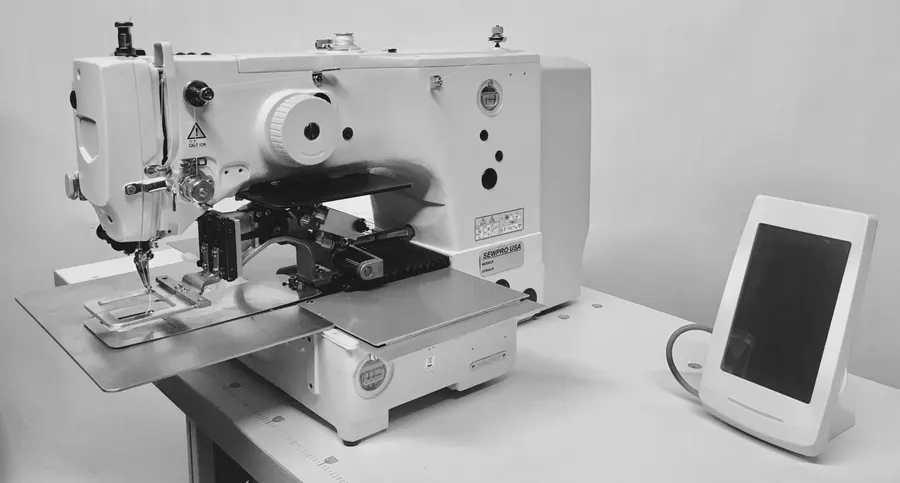
Mechanically it is three things bolted together. A sewing head, usually a heavy-duty lockstitch with a large hook, fixed in place. A clamp that holds the part flat, closed by hand, foot or air. And an X-Y table driven by stepper motors that moves the clamp under the needle in two axes. A controller stores patterns as a list of stitch coordinates and drives the table so the needle lands on each one, synchronized with the head so the needle is out of the material when the table moves.
The result is a stitch pattern that is identical every time. The same number of stitches in the same places with the same thread. A Box-X on a ratchet strap, a bartack on a harness, a label on a bag, a diamond quilt on a seat panel: load, press the pedal, unload. Cycle times run from two seconds for a bartack to a minute for a large quilted panel.
The numbers on a pattern sewer spec sheet
| Sewing field | The X by Y area the clamp can move: 30x40mm (bartacker) to 600x400mm and larger. The pattern must fit inside it. |
|---|---|
| Max speed | 2000 to 3000 stitches per minute. Real cycle time depends on stitch count and how far the table travels between stitches. |
| Stitch length | Programmable per stitch, typically 0.1 to 12.7mm. |
| Hook | Standard, large or extra large. Decides thread capacity and how often the bobbin runs out mid-pattern. |
| Thread range | Garment class: 46 to 92. Heavy-duty class: 138 to 346. |
| Needle system | DPx5 or DPx17 on most; heavy models take 135x17 up to size 230. |
| Clamp | Pneumatic or manual, custom cut to the part. Two-station clamps let the operator load one while the other sews. |
| Pattern memory | Dozens of standard patterns plus hundreds of custom; edited on the controller or a PC and loaded by USB. |
| Foot lift and clamp height | How thick a part fits: 10 to 20mm on heavy models. |
The jobs a pattern sewer is good at
- Rated strap seams. Box-X and W patterns on ratchet straps, cam straps, lifting slings and cargo nets, where the stitch count and thread size set the working load limit and must not vary.
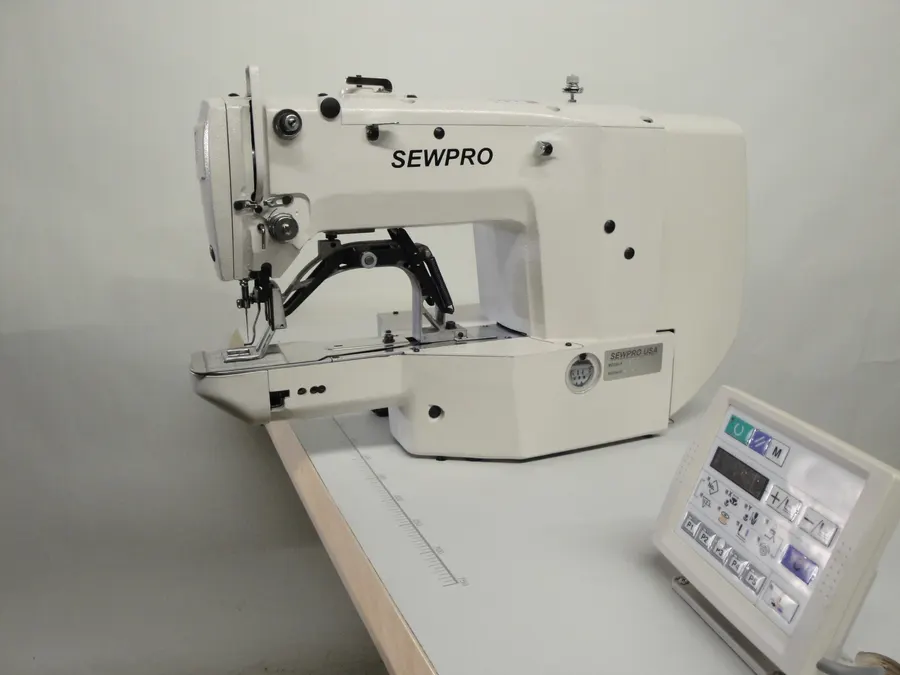
- Bartacks. Reinforcing the ends of straps, belt loops, pocket corners and harness attachment points. The 1900B is a dedicated heavy-duty bartacker.
- Labels, logos and badges. Sewn on in the same place on every bag or garment.
- Attaching hardware. Velcro, D-rings, buckles and webbing loops to panels, where the pattern goes around the hardware.
- Decorative quilting on panels. Diamond and channel stitch on automotive seat panels and furniture, in large field machines like the 2600-3020.
- Shaped seams on flat parts. Pocket outlines, shoe components, glove parts, anything that can be clamped flat and sewn in one plane.
The jobs it is bad at
Anything three-dimensional. The clamp holds a flat part in one plane; it cannot sew around a boot shaft or close a bag. Anything that changes every time, because a new pattern has to be programmed and a clamp made for each new part; a custom shop with no repeat work gains nothing. Very long seams: the field is finite, and a 40 inch panel seam belongs on a long arm, not a pattern sewer. And very thick stacks beyond the clamp height.
The other honest limitation is that a pattern sewer is only as good as its programming and its clamp. A pattern programmed a millimeter off the edge of the webbing will sew into air a thousand times. A clamp that lets the part shift under the needle gives you a thousand crooked Box-X seams. This is why we deliver every pattern sewer with the customer's first patterns programmed, a clamp cut for the actual part, and a test run on it.
What it costs to run
Less than people expect in parts and more than they expect in attention. Thread consumption is the same as hand sewing the pattern. Needles go through more cycles between changes because the machine never deflects a needle by pushing material sideways. Bobbins: a large hook on a heavy model holds enough 207 thread for several hundred Box-X patterns. Power: a servo-driven head and stepper table draw less than a kilowatt. Compressed air for the clamps if pneumatic.
The attention is in setup and in watching for thread breaks. Modern controllers detect a broken thread and stop; the operator rethreads, backs up a few stitches and continues. An operator can tend one pattern sewer while doing other work, or two or three sewers if the cycle is long enough.
Working out whether it pays
Take one repetitive operation in your shop and run the numbers.
- How many of that seam do you sew in a week? Say 600 Box-X seams on tie-down straps.
- How long does one take by hand on a walking foot machine, including positioning, back-tack and trimming? Say 45 seconds.
- That is 7.5 hours a week of a skilled operator's time on one seam.
- On a pattern sewer with a two-station clamp, cycle time including loading is about 8 seconds: 1.3 hours a week, by a less skilled operator who can do other things in between.
- Six hours a week saved, times your loaded labor rate, times 50 weeks. Compare to the machine price.
For most strap, sling and harness shops that calculation comes out in favor of the machine within a year or two, before counting the rejects it eliminates and the fact that every seam is now to spec. For a shop that sews 20 Box-X a week it does not, and we will say so.
Which model for which field
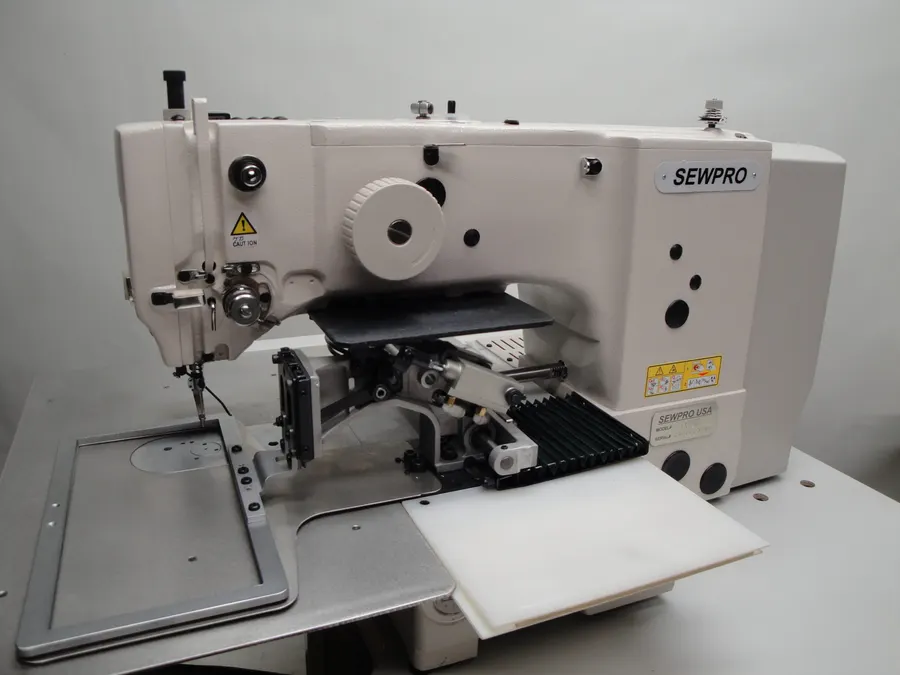
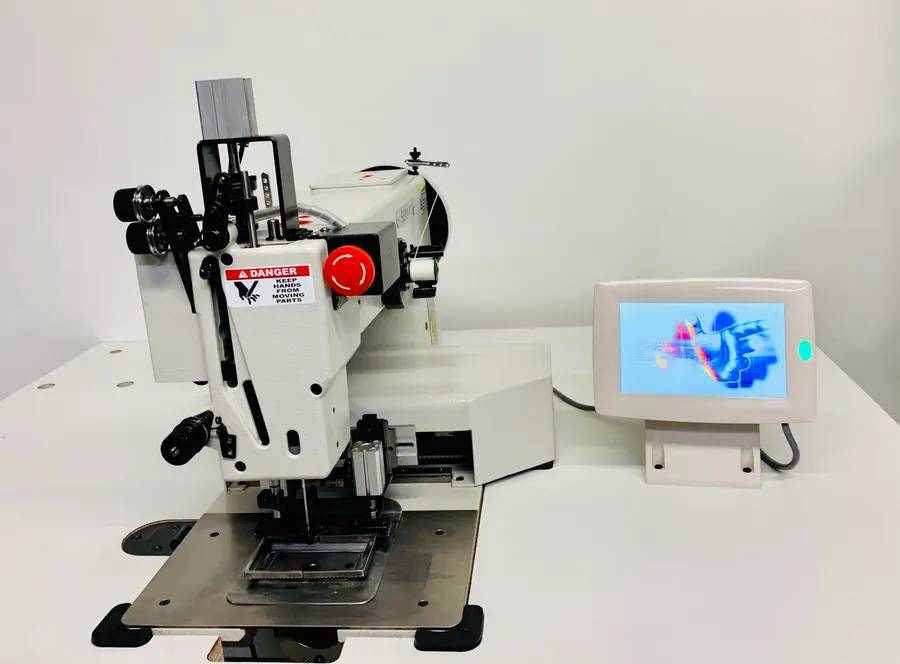
The 1900B bartacker has a 30 by 40mm field for tacks and small reinforcements at 3000 spm. The 210E-1306 and PSM-1306CH have a 130 by 60mm field, the Box-X and label size, with the heavy hook. The 210E-2210 steps up to 220 by 100mm for larger patterns and hardware. The 2600-3020 and PSM-733-3020 have 300 by 200mm fields for seat panels and large reinforcements, the latter on an extra heavy 733 class head. The PSM-5020CH is the 500 by 200mm large-field machine for long sling patterns and quilting.
Programming and training
Patterns are drawn on the controller touch screen or in PC software: lines, arcs, zig-zag fills, stitch length per segment, where to slow down, where to back-tack. From a sewn sample or a drawing it takes us under an hour to program a Box-X with the exact stitch count your rating needs. We deliver the machine with your patterns loaded and spend the installation training your operator on loading, selecting patterns, clearing a thread break and simple edits. After that a new pattern is a phone call or an emailed file.
Questions people ask
How thick can a heavy-duty pattern sewer sew?
Two layers of 2 inch seatbelt webbing with 207 or 277 thread is routine on the heavy models. Up to about 10mm of leather or layered vinyl. Tell us the stack and thread and we will confirm.
Can the same machine do Box-X straps and labels?
Yes, if both fit the field and the thread range. You would change the clamp and the needle between jobs, and select the pattern. Many shops run two or three products on one machine.
What happens when the bobbin runs out mid-pattern?
The controller detects it, stops, and after you change the bobbin it resumes from the last stitch. Large hooks on the heavy models make this rare.
Do you program the patterns?
Yes, your first patterns are programmed and tested before delivery. We train your operator to edit and add patterns, and we are available by phone for new ones.
Machines in this article
 SEWPRO 1900BHeavy-Weight Programmable Pattern Sewing Machine
- SEWPRO 210E-1306Programmable Pattern Sewing Machine (130x60mm) with CP520 Control
 SEWPRO 210E-2210Programmable Pattern Sewing Machine with 220×100mm Area
 SEWPRO PSM-1306CHExtra Heavy-Duty Programmable Sewing Machine (130x60mm)
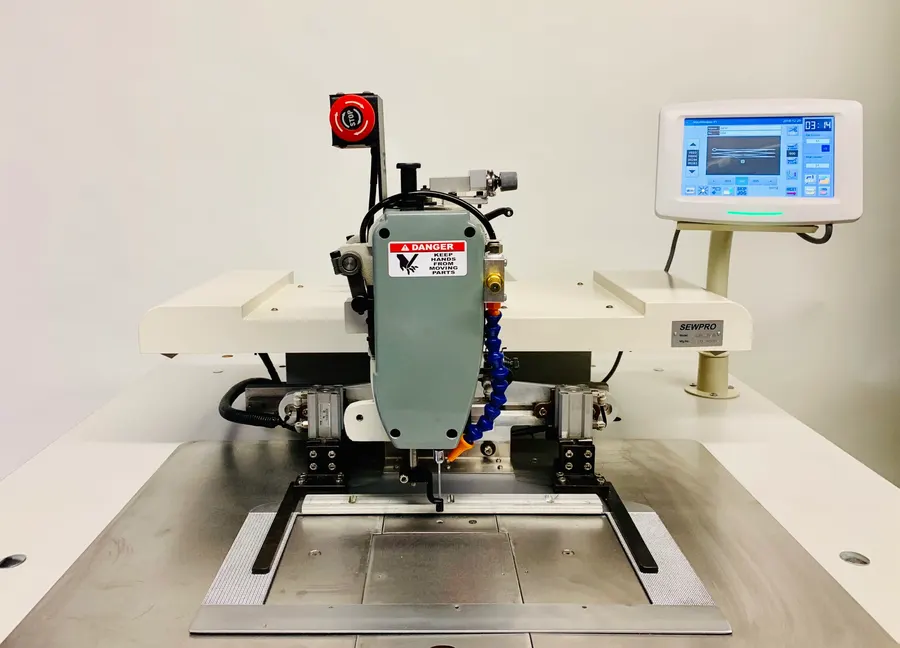 SEWPRO 2600-3020Heavy-Duty Programmable Sewing Machine for Webbing
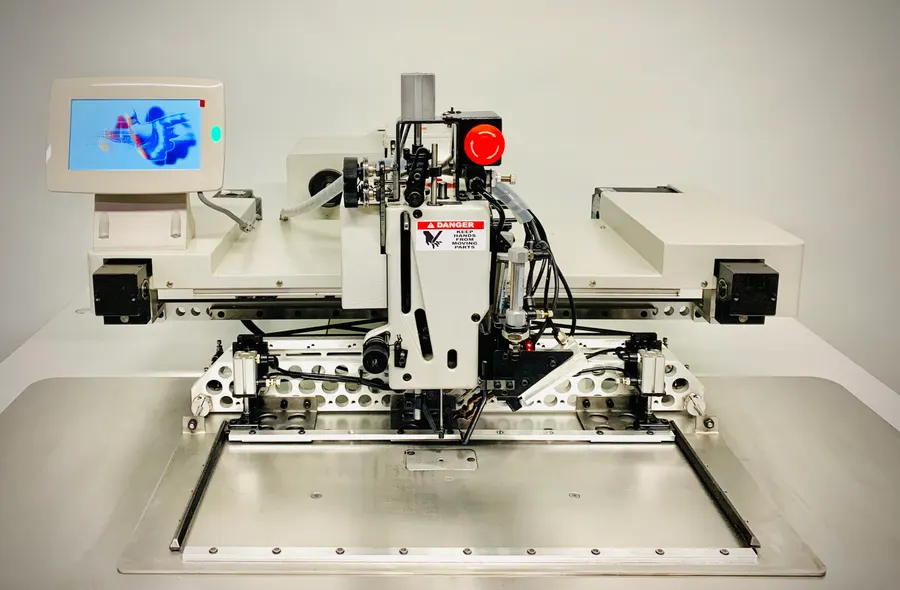 SEWPRO PSM-5020CH500x200mm Extra Heavy-Duty Programmable Sewing Machine
Talk to us
Have a repeated seam? Send a sewn sample and tell us how many a week. We will program it, sew it on the right machine and send you the video and the cycle time.